
Checkout · Supermarket Simulator · read from a local copy
The self-checkout and its rules
The self-checkout is an automated checkout with a check for whether it can be used.
The self-service till in Supermarket Simulator is a machine with conditions: the game checks whether it can be used, tracks whether a customer wants help, and switches its detail by distance.
What the game establishes
- The self-checkout is an automated checkout with a check for whether it can be used. (checked against the game's own files)
- The game tracks whether a customer wants help with it. (checked against the game's own files)
- It knows whether a customer is at the till. (checked against the game's own files)
- Its detail is switched by distance with a renderer of its own. (checked against the game's own files)
- A checkout carries a type, which is how a self-service till is told from a staffed one. (checked against the game's own files)
- The self-checkout has a mirrored variant, with its own checkout materials and a sound effect for the till. (checked against the game's own files)
In play
The self-service till is not only a smaller version of a normal one. It has conditions of its own, and the game checks them rather than leaving the machine to fail quietly.
There is a check for whether it can be used at all. That check is what stops a self-checkout from being treated like an ordinary lane when something about it or the customer makes that impossible.
It also knows whether a customer wants help. That is a separate question from whether the machine works, and the two are tracked apart, which is why a self-checkout can be working and still need a hand.
The game keeps track of whether a customer is at the till. Knowing that a customer is present is what lets the rest of the checkout decide what to do rather than reacting to a machine with no one in front of it.
Its detail is switched by distance. There is a renderer whose job is to decide how much of the machine to draw, so a shop with several self-checkouts can show them all without drawing every one at full detail.
It is still a checkout like any other. A checkout carries a type, and the automated machine is one of those types rather than a system apart, which is why the same code can run a staffed lane and a self-service one.
The barcode side is shared. The scanning documented elsewhere applies here too, so what differs is the rules around the machine rather than the act of scanning.
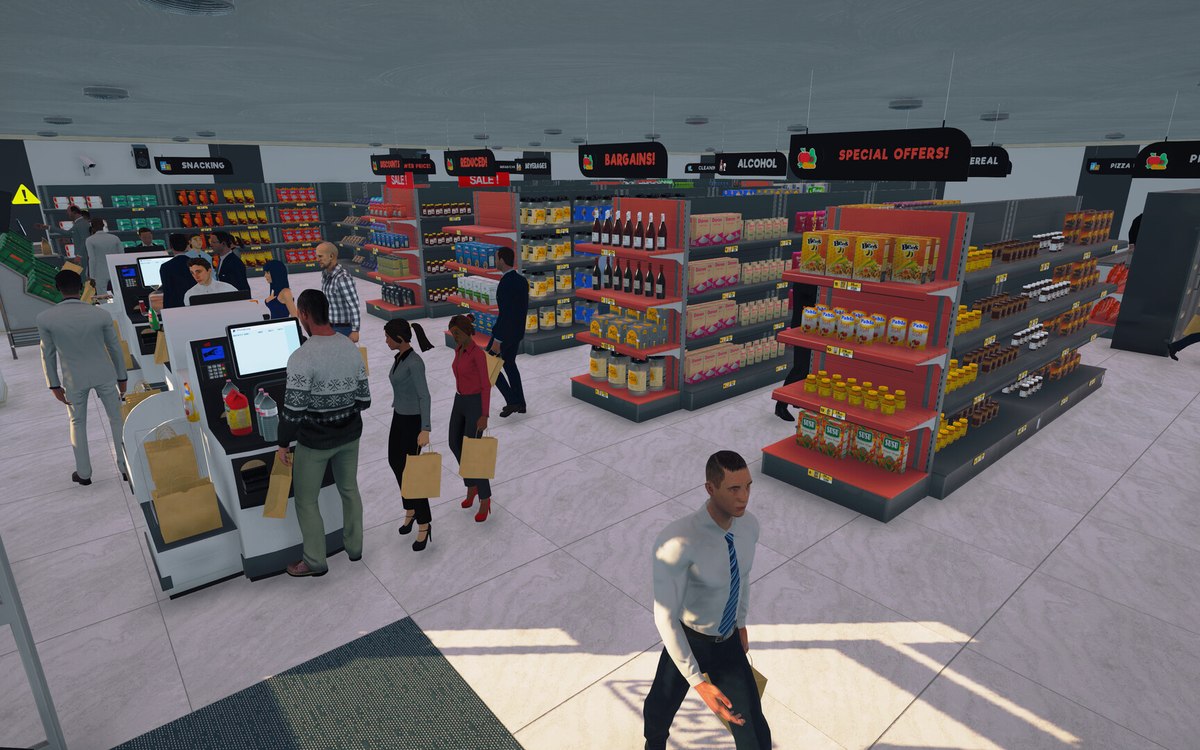
The image beside this entry is the game's own: the self-service machine itself, with its two screens, its scanner bed and the bagging area beside it.
What this entry does not tell you: how many self-checkouts you may have, what makes one unusable, or how often customers ask for help. We have not verified those, so we do not print them.
Related
 CheckoutBarcodes, the scanner and the discount labelA barcode is an object the game spawns, with a spawner and a way of dragging it.
 CheckoutCheckout and cashiersA checkout can be operated by a hired cashier.
Version and sources
A local copy of the game, read only. The grounding for each fact is listed on the technical reference pages; nothing here is estimated. Documented build: 1.6.0 (223).