
Guide
What gets a copy in a shared shop
Which parts of a Supermarket Simulator shop are kept in step between players, so a shared shop can be reasoned about when something disagrees.
Applies to
1.6.0 (223), read from the copy of the game this site was built from (see the sources page)
Before you start
- A shared shop with more than one player
- Something being built or moved
- A disagreement about what each player sees
Steps
- Expect money, stock and licences to be kept by networked managers rather than by each machine.
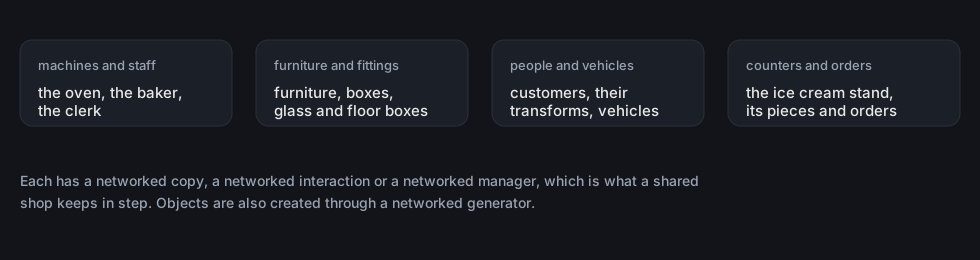
money, the stock and the licences each have a networked manager of their own - Expect the bakery to be shared as two things rather than one.
the bakery's oven and the baker each have a networked copy - Know that a clerk is networked as well as being animated.
the clerk has a networked copy - Expect fittings and the boxes they arrive in to be shared, along with the interaction that opens them.
furniture, the furniture box interaction, floor boxes and the floor box interaction each have networked forms - Expect the shop's glass to have a networked interaction of its own.
glass has a networked interaction - Watch customers being shared rather than simulated twice.
customers, their transform and the view that follows an NPC's transform are networked - Expect vehicles in a shared shop to be shared as well.
a vehicle has a networked component - Remember that the day, the janitor, the market cart and packing are each kept in step too.
the day cycle, the janitor, the market's shopping cart and packed order bags all have networked forms
Common mistakes
- Blaming a desync on the wrong thing when several parts have their own copies.
- Forgetting that the interaction around an object is networked, not only the object.
- Treating the bakery's oven and its worker as one shared thing.
- Assuming a customer is only simulated by whoever is closest.
Related entries
 Playing togetherThe networked copies in a shared shopThe bakery's oven and the baker each have a networked copy.
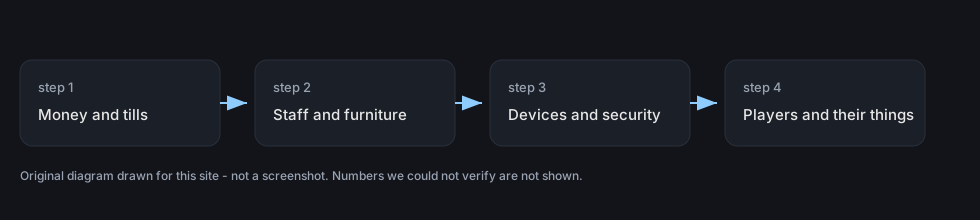 Playing togetherWhat a shared shop keeps in stepThe bank, the checkout, the staff, the furniture, the storage sections and the vehicles each have a networked manager.
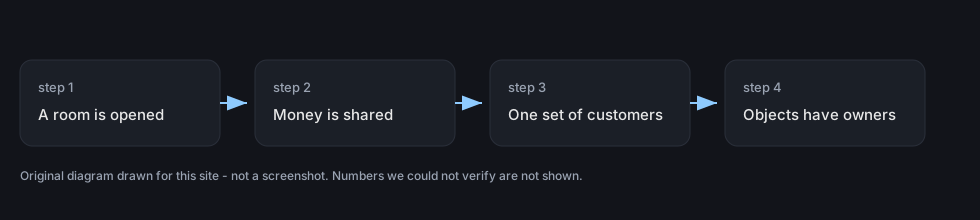 Playing togetherRunning a shop with other playersA shared shop begins with a room: there is a lobby with room settings, a room timer and a record of who is in it.
Sources
A local copy of the game, read only. Grounding for each step is on the technical reference pages; no number is estimated.