
What a shared shop keeps in step
No confirmed picture from the game yet. This subject is kept as a note for now: the facts below are verified against the game's own files, but no image has been confirmed for it, so it is not published as a finished entry and is kept out of search engines.
What the game establishes
- The bank, the checkout, the staff, the furniture, the storage sections and the vehicles each have a networked manager.
- A shared shop keeps a serialization manager of its own.
- The shop computer is networked, and so is interacting with it.
- The scale, the store light, the mop, the display and the rack each have a networked interaction.
- The area a guard watches, the guard and the guard's animation are networked.
- A customer helper and the tool wheel have networked versions.
- Interactions share a common networked form.
- A player can hold an object across the network, with a parent view for it.
- The game broadcasts pings and avatars and listens to each player's room properties.
- There is a manager for leaving a networked session.
In play
A shared shop is not one player's game with guests watching. A whole set of managers exists to keep the parts of the shop in step, so what one player changes is what everyone else is working with.
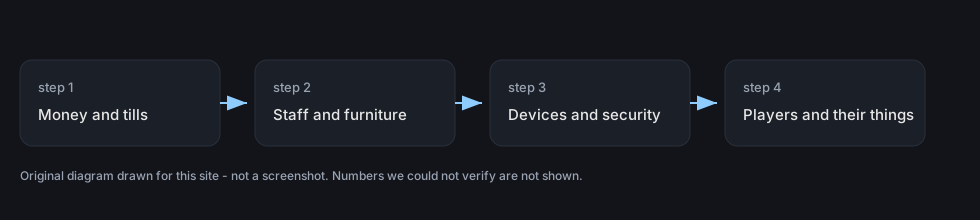
Money and the tills have managers of their own. The bank and the checkout each have a networked manager, which is why takings and transactions are one shared account rather than a private ledger per player.
So do the people and the fittings. There are networked managers for the staff, for the furniture and for the storage sections, so a hire, a moved shelf or a new section appears for the whole crew.
The vehicles do too. A networked manager looks after the vehicles, which is why a van that one player has taken is not still sitting outside for somebody else.
The computer is part of the same arrangement. The shop computer is networked, and so is interacting with it, which is why two players can be at the same terminal and see the same thing.
Devices keep their own networked forms. The scale, the store light and the mop each have a networked interaction, and the display and the rack have their own as well, so using a fixture is a shared event rather than a local animation.
Security is networked from end to end. The area a guard watches, the guard itself and the guard's animation all have networked versions, which is why two players agree on who is being watched.
Smaller things are covered as well. A customer helper and the tool wheel have networked versions, and the game broadcasts pings and avatars while listening to the properties each player carries in the room.
There is also housekeeping for the session. Objects can be held by a player across the network, there is a parent view for them, and a manager exists for leaving a session cleanly rather than dropping out.
What this entry does not tell you: how many players a shop may hold, what any of the managers is limited to, or how much traffic the game sends. We have not verified those numbers, so we do not print them.