
The task layer under the missions
No confirmed picture from the game yet. This subject is kept as a note for now: the facts below are verified against the game's own files, but no image has been confirmed for it, so it is not published as a finished entry and is kept out of search engines.
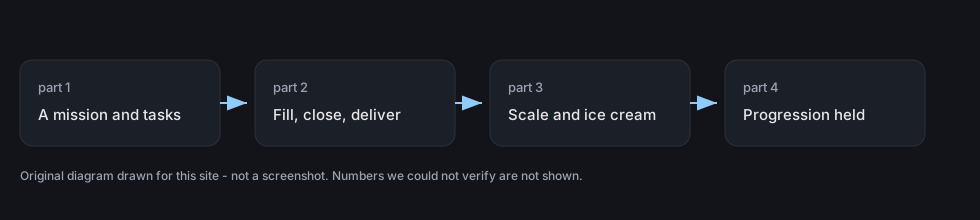
What the game establishes
- A mission is built on tasks of its own rather than being a single instruction.
- Order work is three named tasks: filling, closing and delivering.
- The scale has an interaction task of its own.
- An ice-cream request is an object with a display and a generator for its pictures.
- Progression is kept in a container of its own.
- A teaching job is shown by a display of its own.
In play
Missions are built on tasks. The game keeps a task of its own alongside the mission, the container and the system, which is why a mission can be made of several steps rather than being a single instruction.
Order work is named in three parts: filling an order, closing it and delivering it. They are separate jobs rather than one job of handling an order, which is why an order can be part-finished without being finished.
The scale has an interaction task of its own, so weighing something is a job the game can hand out rather than only an action you perform when you get there.
Ice cream has requests of its own. A request is an object of its own, it has a display, and it has a generator that makes the pictures on it, which is why an order for ice cream can be shown rather than described.
Progression is kept in a container, which is how the game can hold what has been unlocked and what has not without every screen keeping a copy of its own.
Teaching jobs are shown by a display of their own, so a tutorial objective and a mission task are told apart by what shows them rather than by what they ask for.
What this entry does not tell you: how many tasks a mission holds, what a task pays, or how progression is counted. We have not verified those points, so we do not print them.