
How a shop full of things is drawn
No confirmed picture from the game yet. This subject is kept as a note for now: the facts below are verified against the game's own files, but no image has been confirmed for it, so it is not published as a finished entry and is kept out of search engines.
What the game establishes
- The game runs an occlusion controller of its own.
- What may be hidden is recorded as occludee data.
- Repeated objects are held as instance data, with bounds for an instance.
- An indexed static instancer generates the matrices the repeated pieces are placed from.
- Obstacles that people walk around have a manager of their own.
In play
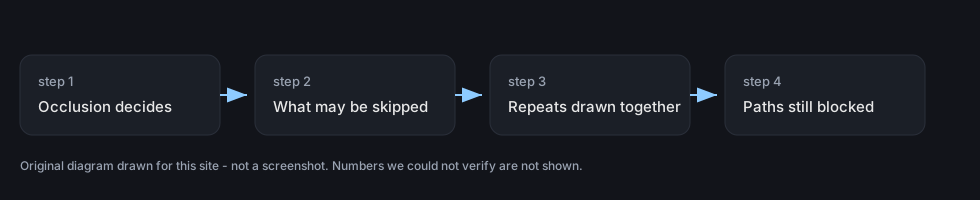
A shop with hundreds of objects is not drawn object by object. The game runs an occlusion controller of its own, which is how it can decide what is worth drawing before anything is put on the screen.
What may be hidden is recorded. There is occludee data of its own, so what can be skipped is a thing the game knows rather than something worked out again each frame.
Objects that repeat are drawn together. The game keeps instance data, with bounds for an instance, which is why a row of identical goods is cheaper to draw than a row of different ones.
The repeated pieces are placed from matrices. There is an indexed static instancer that generates the matrices for them, which is how the same object can appear many times without many copies of the object.
People still have to walk around it. There is a manager for navigation obstacles of its own, so a fixture blocks a shopper's path without the game having to test every wall by hand.
What this entry does not tell you: how many objects a shop can hold, when something is skipped, or which objects are instanced. We have not verified those numbers, so we do not print them.